
Graph Algorithms Cheat Sheet

We summarize the performance characteristics of classic algorithms anddata structures for sorting, priority queues, symbol tables, and graph processing.
- Graph Algorithms Book
- Graph Algorithms Cheat Sheet Pdf
- All Graph Algorithms
- C++ Stl Algorithm Cheat Sheet
- Graph Algorithms Cheat Sheet Free
Algorithms need not be boring or hard to use. In fact, algorithms surround you in many ways that you might not have thought about, and you use them every day to perform important tasks. However, you need to be able to use algorithms without having to become a mathematician. Programming languages enable you to describe. About: I made this website as a fun project to help me understand better: algorithms, data structures and big O notation. And also to have some practice in: Java. Know Thy Complexities! This webpage covers the space and time Big-O complexities of common algorithms used in Computer Science. When preparing for technical interviews in the past, I found myself spending hours crawling the internet putting together the best, average, and worst case complexities for search and sorting algorithms so that I wouldn't be stumped when asked about them. The Complete Cypher Cheat Sheet. Table of Contents. Cypher is the most widely adopted, fully specified, and open query language for property graph databases. It provides an intuitive and fast way to work with property graphs.
We also summarize some of the mathematics useful in the analysis of algorithms, including commonly encountered functions;useful formulas and appoximations; properties of logarithms;asymptotic notations; and solutions to divide-and-conquer recurrences.

Sorting.
The table below summarizes the number of compares for a variety of sortingalgorithms, as implemented in this textbook.It includes leading constants but ignores lower-order terms.| ALGORITHM | CODE | STABLE | BEST | AVERAGE | WORST | REMARKS | |
|---|---|---|---|---|---|---|---|
| selection sort | Selection.java | ✔ | ½ n 2 | ½ n 2 | ½ n 2 | n exchanges; quadratic in best case | |
| insertion sort | Insertion.java | ✔ | ✔ | n | ¼ n 2 | ½ n 2 | use for small or partially-sorted arrays |
| bubble sort | Bubble.java | ✔ | ✔ | n | ½ n 2 | ½ n 2 | rarely useful; use insertion sort instead |
| shellsort | Shell.java | ✔ | n log3n | unknown | c n 3/2 | tight code; subquadratic | |
| mergesort | Merge.java | ✔ | ½ n lg n | n lg n | n lg n | n log n guarantee; stable | |
| quicksort | Quick.java | ✔ | n lg n | 2 n ln n | ½ n 2 | n log n probabilistic guarantee; fastest in practice | |
| heapsort | Heap.java | ✔ | n† | 2 n lg n | 2 n lg n | n log n guarantee; in place | |
| †n lg n if all keys are distinct | |||||||
Priority queues.
The table below summarizes the order of growth of the running time ofoperations for a variety of priority queues, as implemented in this textbook.It ignores leading constants and lower-order terms.Except as noted, all running times are worst-case running times.| DATA STRUCTURE | CODE | INSERT | MIN | DELETE | MERGE | ||
|---|---|---|---|---|---|---|---|
| array | BruteIndexMinPQ.java | 1 | n | n | 1 | 1 | n |
| binary heap | IndexMinPQ.java | log n | log n | 1 | log n | log n | n |
| d-way heap | IndexMultiwayMinPQ.java | logdn | d logdn | 1 | logdn | d logdn | n |
| binomial heap | IndexBinomialMinPQ.java | 1 | log n | 1 | log n | log n | log n |
| Fibonacci heap | IndexFibonacciMinPQ.java | 1 | log n† | 1 | 1 † | log n† | 1 |
| † amortized guarantee | |||||||
Symbol tables.
The table below summarizes the order of growth of the running time ofoperations for a variety of symbol tables, as implemented in this textbook.It ignores leading constants and lower-order terms.| worst case | average case | ||||||
|---|---|---|---|---|---|---|---|
| DATA STRUCTURE | CODE | SEARCH | INSERT | DELETE | SEARCH | INSERT | DELETE |
| sequential search (in an unordered list) | SequentialSearchST.java | n | n | n | n | n | n |
| binary search (in a sorted array) | BinarySearchST.java | log n | n | n | log n | n | n |
| binary search tree (unbalanced) | BST.java | n | n | n | log n | log n | sqrt(n) |
| red-black BST (left-leaning) | RedBlackBST.java | log n | log n | log n | log n | log n | log n |
| AVL | AVLTreeST.java | log n | log n | log n | log n | log n | log n |
| hash table (separate-chaining) | SeparateChainingHashST.java | n | n | n | 1 † | 1 † | 1 † |
| hash table (linear-probing) | LinearProbingHashST.java | n | n | n | 1 † | 1 † | 1 † |
| † uniform hashing assumption | |||||||
Graph processing.
The table below summarizes the order of growth of the worst-case running time and memory usage (beyond the memory for the graph itself)for a variety of graph-processing problems, as implemented in this textbook.It ignores leading constants and lower-order terms.All running times are worst-case running times.| PROBLEM | ALGORITHM | CODE | TIME | SPACE |
|---|---|---|---|---|
| path | DFS | DepthFirstPaths.java | E + V | V |
| shortest path (fewest edges) | BFS | BreadthFirstPaths.java | E + V | V |
| cycle | DFS | Cycle.java | E + V | V |
| directed path | DFS | DepthFirstDirectedPaths.java | E + V | V |
| shortest directed path (fewest edges) | BFS | BreadthFirstDirectedPaths.java | E + V | V |
| directed cycle | DFS | DirectedCycle.java | E + V | V |
| topological sort | DFS | Topological.java | E + V | V |
| bipartiteness / odd cycle | DFS | Bipartite.java | E + V | V |
| connected components | DFS | CC.java | E + V | V |
| strong components | Kosaraju–Sharir | KosarajuSharirSCC.java | E + V | V |
| strong components | Tarjan | TarjanSCC.java | E + V | V |
| strong components | Gabow | GabowSCC.java | E + V | V |
| Eulerian cycle | DFS | EulerianCycle.java | E + V | E + V |
| directed Eulerian cycle | DFS | DirectedEulerianCycle.java | E + V | V |
| transitive closure | DFS | TransitiveClosure.java | V (E + V) | V 2 |
| minimum spanning tree | Kruskal | KruskalMST.java | E log E | E + V |
| minimum spanning tree | Prim | PrimMST.java | E log V | V |
| minimum spanning tree | Boruvka | BoruvkaMST.java | E log V | V |
| shortest paths (nonnegative weights) | Dijkstra | DijkstraSP.java | E log V | V |
| shortest paths (no negative cycles) | Bellman–Ford | BellmanFordSP.java | V (V + E) | V |
| shortest paths (no cycles) | topological sort | AcyclicSP.java | V + E | V |
| all-pairs shortest paths | Floyd–Warshall | FloydWarshall.java | V 3 | V 2 |
| maxflow–mincut | Ford–Fulkerson | FordFulkerson.java | EV (E + V) | V |
| bipartite matching | Hopcroft–Karp | HopcroftKarp.java | V ½ (E + V) | V |
| assignment problem | successive shortest paths | AssignmentProblem.java | n 3 log n | n 2 |
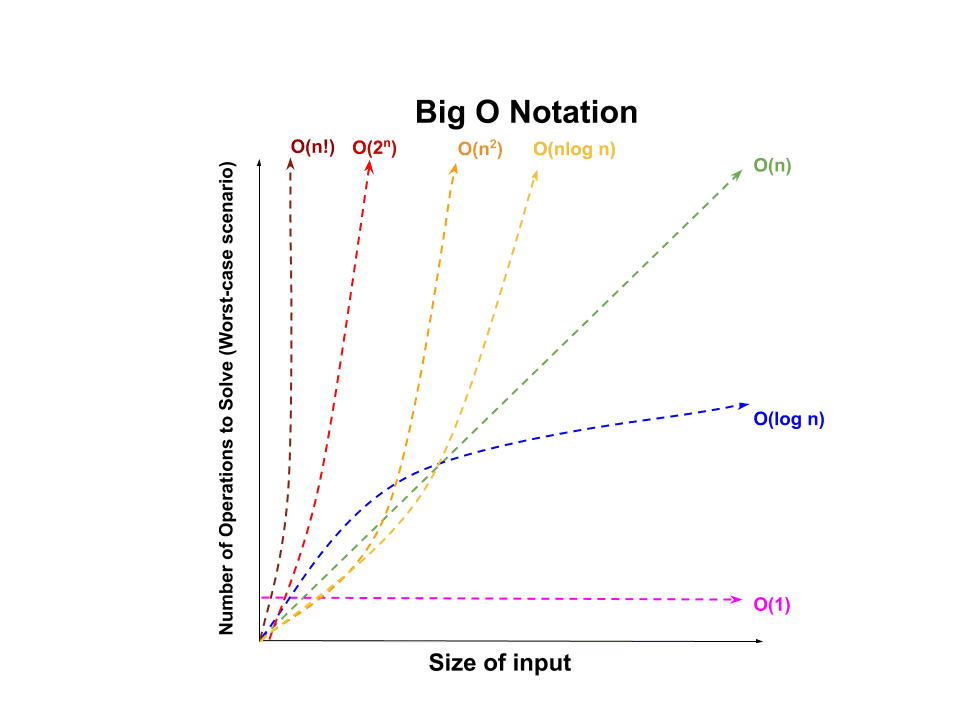
Commonly encountered functions.
Here are some functions that are commonly encounteredwhen analyzing algorithms.| FUNCTION | NOTATION | DEFINITION |
|---|---|---|
| floor | ( lfloor x rfloor ) | greatest integer (; le ; x) |
| ceiling | ( lceil x rceil ) | smallest integer (; ge ; x) |
| binary logarithm | ( lg x) or (log_2 x) | (y) such that (2^{,y} = x) |
| natural logarithm | ( ln x) or (log_e x ) | (y) such that (e^{,y} = x) |
| common logarithm | ( log_{10} x ) | (y) such that (10^{,y} = x) |
| iterated binary logarithm | ( lg^* x ) | (0) if (x le 1;; 1 + lg^*(lg x)) otherwise |
| harmonic number | ( H_n ) | (1 + 1/2 + 1/3 + ldots + 1/n) |
| factorial | ( n! ) | (1 times 2 times 3 times ldots times n) |
| binomial coefficient | ( n choose k ) | ( frac{n!}{k! ; (n-k)!}) |
Useful formulas and approximations.
Here are some useful formulas for approximations that are widely used in the analysis of algorithms.- Harmonic sum: (1 + 1/2 + 1/3 + ldots + 1/n sim ln n)
- Triangular sum: (1 + 2 + 3 + ldots + n = n , (n+1) , / , 2 sim n^2 ,/, 2)
- Sum of squares: (1^2 + 2^2 + 3^2 + ldots + n^2 sim n^3 , / , 3)
- Geometric sum: If (r neq 1), then(1 + r + r^2 + r^3 + ldots + r^n = (r^{n+1} - 1) ; /; (r - 1))
- (r = 1/2): (1 + 1/2 + 1/4 + 1/8 + ldots + 1/2^n sim 2)
- (r = 2): (1 + 2 + 4 + 8 + ldots + n/2 + n = 2n - 1 sim 2n), when (n) is a power of 2
- Stirling's approximation: (lg (n!) = lg 1 + lg 2 + lg 3 + ldots + lg n sim n lg n)
- Exponential: ((1 + 1/n)^n sim e; ;;(1 - 1/n)^n sim 1 / e)
- Binomial coefficients: ({n choose k} sim n^k , / , k!) when (k) is a small constant
- Approximate sum by integral: If (f(x)) is a monotonically increasing function, then( displaystyle int_0^n f(x) ; dx ; le ; sum_{i=1}^n ; f(i) ; le ; int_1^{n+1} f(x) ; dx)
Properties of logarithms.
- Definition: (log_b a = c) means (b^c = a).We refer to (b) as the base of the logarithm.
- Special cases: (log_b b = 1,; log_b 1 = 0 )
- Inverse of exponential: (b^{log_b x} = x)
- Product: (log_b (x times y) = log_b x + log_b y )
- Division: (log_b (x div y) = log_b x - log_b y )
- Finite product: (log_b ( x_1 times x_2 times ldots times x_n) ; = ; log_b x_1 + log_b x_2 + ldots + log_b x_n)
- Changing bases: (log_b x = log_c x ; / ; log_c b )
- Rearranging exponents: (x^{log_b y} = y^{log_b x})
- Exponentiation: (log_b (x^y) = y log_b x )
Aymptotic notations: definitions.
| NAME | NOTATION | DESCRIPTION | DEFINITION |
|---|---|---|---|
| Tilde | (f(n) sim g(n); ) | (f(n)) is equal to (g(n)) asymptotically (including constant factors) | ( ; displaystyle lim_{n to infty} frac{f(n)}{g(n)} = 1) |
| Big Oh | (f(n)) is (O(g(n))) | (f(n)) is bounded above by (g(n)) asymptotically (ignoring constant factors) | there exist constants (c > 0) and (n_0 ge 0) such that (0 le f(n) le c cdot g(n)) forall (n ge n_0) |
| Big Omega | (f(n)) is (Omega(g(n))) | (f(n)) is bounded below by (g(n)) asymptotically (ignoring constant factors) | ( g(n) ) is (O(f(n))) |
| Big Theta | (f(n)) is (Theta(g(n))) | (f(n)) is bounded above and below by (g(n)) asymptotically (ignoring constant factors) | ( f(n) ) is both (O(g(n))) and (Omega(g(n))) |
| Little oh | (f(n)) is (o(g(n))) | (f(n)) is dominated by (g(n)) asymptotically (ignoring constant factors) | ( ; displaystyle lim_{n to infty} frac{f(n)}{g(n)} = 0) |
| Little omega | (f(n)) is (omega(g(n))) | (f(n)) dominates (g(n)) asymptotically (ignoring constant factors) | ( g(n) ) is (o(f(n))) |
Common orders of growth.
| NAME | NOTATION | EXAMPLE | CODE FRAGMENT |
|---|---|---|---|
| Constant | (O(1)) | array access arithmetic operation function call | |
| Logarithmic | (O(log n)) | binary search in a sorted array insert in a binary heap search in a red–black tree | |
| Linear | (O(n)) | sequential search grade-school addition BFPRT median finding | |
| Linearithmic | (O(n log n)) | mergesort heapsort fast Fourier transform | |
| Quadratic | (O(n^2)) | enumerate all pairs insertion sort grade-school multiplication | |
| Cubic | (O(n^3)) | enumerate all triples Floyd–Warshall grade-school matrix multiplication | |
| Polynomial | (O(n^c)) | ellipsoid algorithm for LP AKS primality algorithm Edmond's matching algorithm | |
| Exponential | (2^{O(n^c)}) | enumerating all subsets enumerating all permutations backtracing search |
Asymptotic notations: properties.
- Reflexivity: (f(n)) is (O(f(n))).
- Constants: If (f(n)) is (O(g(n))) and ( c > 0 ),then (c cdot f(n)) is (O(g(n)))).
- Products: If (f_1(n)) is (O(g_1(n))) and ( f_2(n) ) is (O(g_2(n)))),then (f_1(n) cdot f_2(n)) is (O(g_1(n) cdot g_2(n)))).
- Sums: If (f_1(n)) is (O(g_1(n))) and ( f_2(n) ) is (O(g_2(n)))),then (f_1(n) + f_2(n)) is (O(max { g_1(n) , g_2(n) })).
- Transitivity: If (f(n)) is (O(g(n))) and ( g(n) ) is (O(h(n))),then ( f(n) ) is (O(h(n))).
- Polynomials: Let (f(n) = a_0 + a_1 n + ldots + a_d n^d) with(a_d > 0). Then, ( f(n) ) is (Theta(n^d)).
- Logarithms and polynomials: ( log_b n ) is (O(n^d)) for every ( b > 0) and every ( d > 0 ).
- Exponentials and polynomials: ( n^d ) is (O(r^n)) for every ( r > 0) and every ( d > 0 ).
- Factorials: ( n! ) is ( 2^{Theta(n log n)} ).
- Limits: If ( ; displaystyle lim_{n to infty} frac{f(n)}{g(n)} = c)for some constant ( 0 < c < infty), then(f(n)) is (Theta(g(n))).
- Limits: If ( ; displaystyle lim_{n to infty} frac{f(n)}{g(n)} = 0),then (f(n)) is (O(g(n))) but not (Theta(g(n))).
- Limits: If ( ; displaystyle lim_{n to infty} frac{f(n)}{g(n)} = infty),then (f(n)) is (Omega(g(n))) but not (O(g(n))).
Here are some examples.
| FUNCTION | (o(n^2)) | (O(n^2)) | (Theta(n^2)) | (Omega(n^2)) | (omega(n^2)) | (sim 2 n^2) | (sim 4 n^2) |
|---|---|---|---|---|---|---|---|
| (log_2 n) | ✔ | ✔ | |||||
| (10n + 45) | ✔ | ✔ | |||||
| (2n^2 + 45n + 12) | ✔ | ✔ | ✔ | ✔ | |||
| (4n^2 - 2 sqrt{n}) | ✔ | ✔ | ✔ | ✔ | |||
| (3n^3) | ✔ | ✔ | |||||
| (2^n) | ✔ | ✔ |
Divide-and-conquer recurrences.
For each of the following recurrences we assume (T(1) = 0)and that (n,/,2) means either (lfloor n,/,2 rfloor) or(lceil n,/,2 rceil).| RECURRENCE | (T(n)) | EXAMPLE |
|---|---|---|
| (T(n) = T(n,/,2) + 1) | (sim lg n) | binary search |
| (T(n) = 2 T(n,/,2) + n) | (sim n lg n) | mergesort |
| (T(n) = T(n-1) + n) | (sim frac{1}{2} n^2) | insertion sort |
| (T(n) = 2 T(n,/,2) + 1) | (sim n) | tree traversal |
| (T(n) = 2 T(n-1) + 1) | (sim 2^n) | towers of Hanoi |
| (T(n) = 3 T(n,/,2) + Theta(n)) | (Theta(n^{log_2 3}) = Theta(n^{1.58...})) | Karatsuba multiplication |
| (T(n) = 7 T(n,/,2) + Theta(n^2)) | (Theta(n^{log_2 7}) = Theta(n^{2.81...})) | Strassen multiplication |
| (T(n) = 2 T(n,/,2) + Theta(n log n)) | (Theta(n log^2 n)) | closest pair |
Master theorem.
Graph Algorithms Book
Let (a ge 1), (b ge 2), and (c > 0) and suppose that(T(n)) is a function on the non-negative integers that satisfiesthe divide-and-conquer recurrence$$T(n) = a ; T(n,/,b) + Theta(n^c)$$with (T(0) = 0) and (T(1) = Theta(1)), where (n,/,b) meanseither (lfloor n,/,b rfloor) or either (lceil n,/,b rceil).Graph Algorithms Cheat Sheet Pdf
- If (c < log_b a), then (T(n) = Theta(n^{log_{,b} a}))
- If (c = log_b a), then (T(n) = Theta(n^c log n))
- If (c > log_b a), then (T(n) = Theta(n^c))
All Graph Algorithms
Remark: there are many different versions of the master theorem. The Akra–Bazzi theoremis among the most powerful.C++ Stl Algorithm Cheat Sheet
Graph Algorithms Cheat Sheet Free
Last modified on September 12, 2020.
Copyright © 2000–2019Robert SedgewickandKevin Wayne.All rights reserved.